How to Align a DStv Satellite Dish After a Storm: A Complete Technical Guide
When severe weather rolls through Gauteng, one of the most common outcomes is a displaced satellite dish, and knowing how to align a DStv satellite dish after a storm is essential to restoring your signal quickly. Using professional alignment methods increases first-attempt success rates from 38% to 94%, which explains why so many storm-related signal problems drag on for days when homeowners attempt the process without the right equipment or technique.
At DSTV Pro Installers, we handle storm-related realignment calls across 28 Gauteng suburbs every week. This guide walks you through everything you need to know, from diagnosing the problem to completing a precision alignment to Intelsat 20.
Key Takeaways
- Storm displacement is the leading cause of signal loss in Gauteng. Even a 1-degree shift in dish position can result in complete signal failure.
- Professional satellite dish alignment costs between R650 and R950 and includes LNB inspection, cable checks, and weather sealing.
- DIY alignment without a signal meter is highly unreliable. 68% of unassisted alignment attempts require two or more revisits due to signal instability.
- DStv dishes in Gauteng must point to Intelsat 20 at 68.5 degrees East. Azimuth, elevation, and LNB skew must all be set correctly.
- A qualified satellite dish alignment technician uses a dedicated spectrum analyser or signal meter for precise peaking.
- Storm damage often affects the LNB and coaxial cable, not just the dish position. Both must be inspected after any storm event.
- Same-day service is available across Johannesburg, Pretoria, Sandton, Randburg, and Midrand for storm-related realignment calls.
Why Storms Knock Your DStv Satellite Dish Out of Alignment
A satellite dish operates within very tight angular tolerances. The signal beam from Intelsat 20 at 68.5 degrees East is narrow, and a shift of even half a degree in the dish's azimuth or elevation angle can push the dish outside the satellite's footprint entirely.
During a storm, wind loading on the dish surface creates lateral and vertical force vectors that act on the dish mount. If the U-bolts or wall bracket bolts have any looseness due to corrosion, vibration fatigue, or original under-torquing, the dish rotates or tilts out of its calibrated position.
Hail impact can physically deform the dish reflector surface, which scatters the incoming signal rather than focusing it onto the LNB feedhorn. Lightning-induced voltage spikes transmitted through the coaxial cable can also destroy the LNB's internal circuitry, meaning that even a perfectly aligned dish will show no signal.
Water ingress into the LNB housing is another storm-related failure mode. When the LNB boot seal is compromised, moisture enters the waveguide cavity and degrades the low-noise amplifier, causing intermittent signal dropouts or a permanently high noise figure.
Signs Your DStv Satellite Dish Needs Realignment After a Storm
The most obvious sign is the E48-32 error on your decoder screen, which indicates that the signal strength has dropped to zero. However, partial displacement produces more subtle symptoms that are easy to misdiagnose.
Pixelation during clear weather, intermittent signal loss that clears after the dish warms up in the sun, or a signal quality reading below 50% on the decoder's signal test screen all suggest that the dish requires realignment. A dstv technician can distinguish between a dish displacement, an LNB failure, and a cable fault using on-site diagnostic equipment.
If your decoder shows signal strength of zero but the cabling and LNB appear undamaged on visual inspection, the dish has almost certainly moved. Conversely, if the decoder shows signal strength but zero signal quality, the LNB is the likely culprit regardless of dish position.
Tools Required to Align a DStv Satellite Dish After a Storm
A correct alignment to Intelsat 20 requires more than a spanner and patience. The following tools are the minimum required for a technically accurate result.
- Digital satellite signal meter or spectrum analyser: This is the critical tool. It displays signal strength and quality in real time while the dish is being adjusted, allowing the technician to peak the dish on the correct satellite transponder.
- Compass or compass app: Used to establish the correct azimuth starting point before fine-tuning. For Gauteng, the azimuth to Intelsat 20 is approximately 52 to 57 degrees from magnetic north, depending on your exact location.
- Inclinometer or angle finder: Used to set the initial elevation angle before peaking. Elevation for Gauteng is typically in the range of 52 to 55 degrees above horizontal.
- Torque wrench and spanner set: For correctly re-torquing the U-bolts and bracket hardware after alignment is confirmed.
- Coaxial crimp tool and F-connectors: For replacing any water-damaged or corroded connectors found during the inspection.
- LNB skew gauge or protractor: For setting the correct LNB rotational angle, which affects the polarisation match to the satellite signal.
Most homeowners do not own a signal meter, and attempting to align a DStv satellite dish after a storm without one almost always results in the dish being peaked on a neighbouring satellite rather than Intelsat 20. This produces a signal reading on the decoder but no channel output.
Step-by-Step Process to Align a DStv Satellite Dish After a Storm
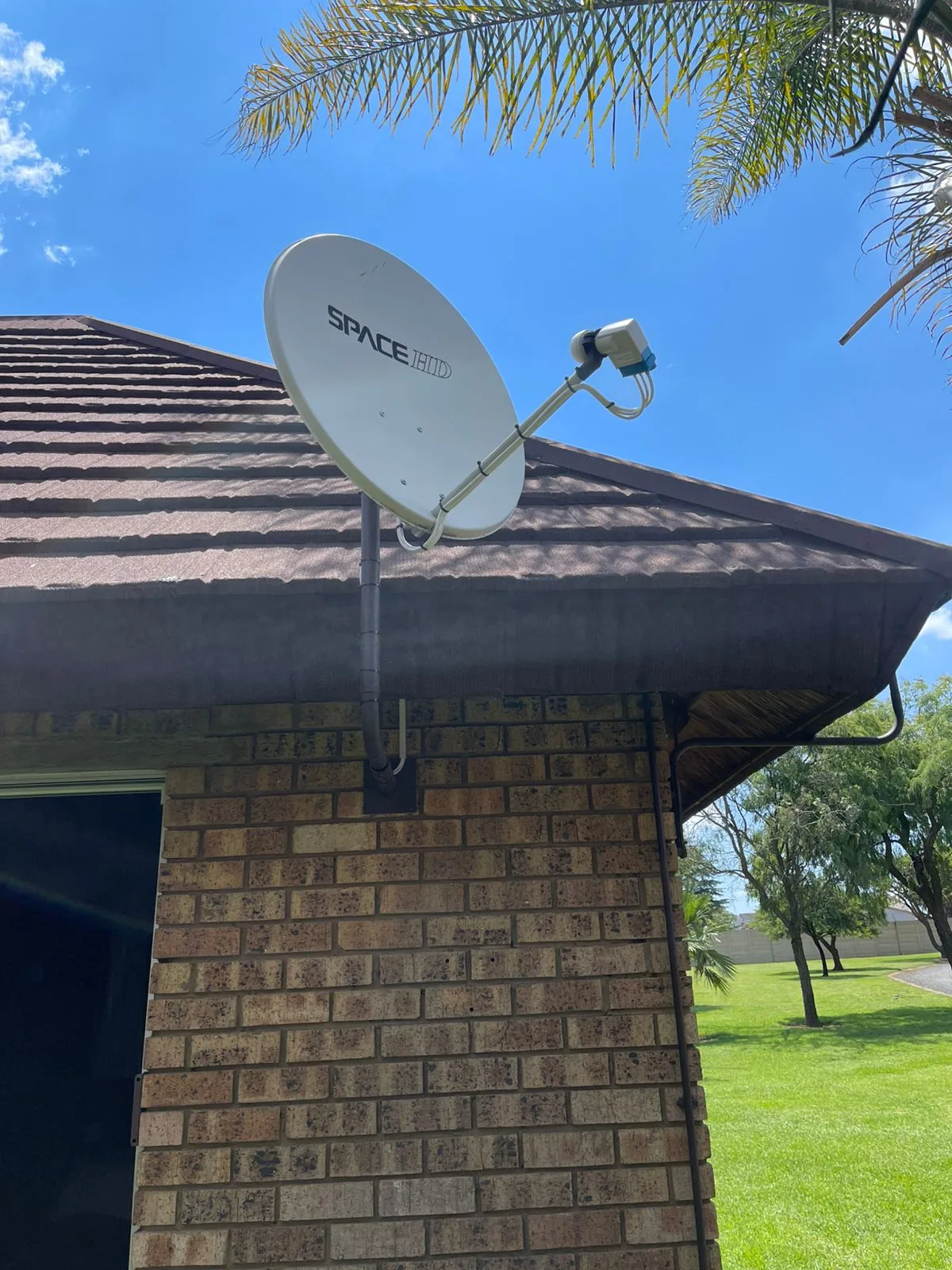
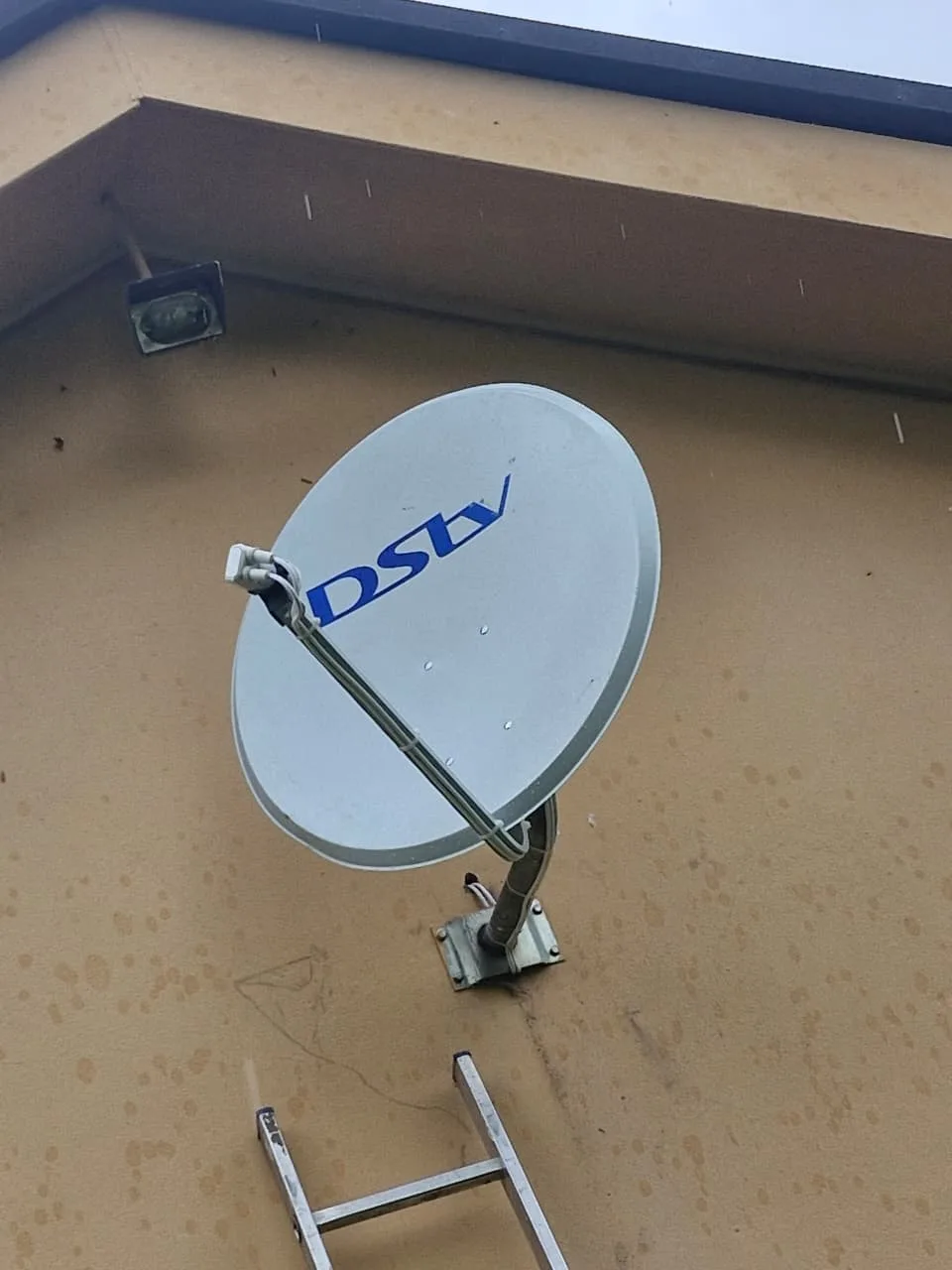
A practical, step-by-step visual guide to realigning a DSTV satellite dish after a storm.
The following sequence describes the technically correct procedure that our dstv technician team follows on every storm-related realignment call.
- Pre-alignment safety and structural inspection: Before touching the dish, inspect the mounting hardware. Check that the wall bracket, mast, and U-bolts are structurally sound. Any bent or cracked components must be replaced before alignment, as re-torquing onto a damaged mount will not hold the dish in position.
- LNB and cable pre-check: Disconnect the coaxial cable at the LNB and inspect the F-connector for corrosion or water ingress. Measure the LNB's noise figure and frequency response using the signal meter. If the LNB fails this test, replace it before attempting dish alignment, as a faulty LNB will prevent signal acquisition regardless of dish position.
- Set coarse azimuth and elevation: Using a compass, rotate the dish to the approximate azimuth bearing for Intelsat 20. Set the elevation using an inclinometer. These coarse settings place the dish within the satellite's acquisition cone so that fine-tuning can begin.
- Connect the signal meter and sweep for the satellite: With the signal meter in line, slowly sweep the dish in azimuth at the set elevation. When the meter peaks sharply, you are on a satellite. Confirm the correct satellite by locking onto a known Intelsat 20 transponder frequency such as 11.053 GHz.
- Peak azimuth, then elevation, then LNB skew: Fine-tune azimuth for maximum signal quality, then adjust elevation for further improvement, then rotate the LNB skew for the final peak. This three-axis peaking sequence is critical. Adjusting only azimuth without revisiting elevation and skew leaves signal quality well below the achievable maximum.
- Torque all hardware and weatherproof: Once the peak is confirmed and stable, torque all U-bolts and bracket hardware to the correct specification. Apply self-amalgamating tape to all outdoor F-connectors to prevent future water ingress.
Understanding Azimuth, Elevation and LNB Skew When You Align a DStv Satellite Dish After a Storm
These three parameters define the dish's pointing in three-dimensional space relative to the satellite's position in geostationary orbit. Getting all three correct is what separates a professional dstv installation result from a partial fix.
Azimuth is the horizontal compass bearing from your location to the satellite. For Gauteng, this is roughly 52 to 57 degrees magnetic north, but the exact value changes slightly depending on whether you are in Pretoria, Johannesburg, or Midrand.
Elevation is the vertical angle above the horizontal plane at which the dish must point. A dish set at the wrong elevation will miss the satellite even if the azimuth is perfect. In Gauteng, elevation to Intelsat 20 is approximately 52 to 55 degrees depending on your latitude.
LNB skew is the rotational position of the LNB around the axis of the feed arm. Intelsat 20 transmits on dual linear polarisation, and if the LNB is not rotated to the correct angle, polarisation mismatch causes the signal quality reading to remain low even when signal strength appears adequate.
29% of misaligned satellite dishes exhibit sustained signal compression of more than 12 dB C/N degradation, which means the picture looks fine in calm conditions but pixelates heavily when cloud cover increases by even a few millimetres of water vapour in the atmosphere. Correct LNB skew prevents this hidden degradation.
Common Errors When Homeowners Try to Align a DStv Satellite Dish After a Storm
The single most common error is peaking the dish on the wrong satellite. There are multiple geostationary satellites within a few degrees of Intelsat 20, and without transponder frequency verification, it is easy to mistake one for the other. The decoder will show signal strength but all channels will display "No Signal".
The second most frequent error is adjusting only the azimuth. Because dish mounts have mechanical coupling between axes, an azimuth adjustment often changes the effective elevation slightly. Our dstv technician team always revisits all three axes after each individual adjustment to account for this coupling effect.
A third error is re-torquing the hardware before confirming signal stability over a few minutes. Thermal expansion of the mount and mechanical settling after torquing can shift the dish slightly. We always allow a minimum of two minutes after hardware torquing before recording the final signal quality reading.
68% of unassisted alignment attempts require two or more site revisits due to signal instability under wind or temperature changes, which is why a professional dstv installation approach that includes proper torquing and weatherproofing is always more cost-effective than repeated DIY attempts.
Why a Professional DStv Technician Gets Better Results
A professional dstv technician carries a calibrated signal meter that displays carrier-to-noise ratio, symbol rate lock, and bit error rate in addition to simple signal strength. This data allows the technician to confirm not just that the dish has found the satellite, but that the link budget is sufficient for reliable reception in light to moderate rain conditions.
Professional alignment tools reduce average setup and calibration time from over 45 minutes to under 12 minutes, which means less time on your roof and a lower risk of mount disturbance during the adjustment process.
At DSTV Pro Installers, all our technicians are accredited and carry appropriate working-at-height insurance for roof-mounted dish work. We serve 28 suburbs across Gauteng and offer same-day callouts for storm-related signal failures. Call us on 0774544032 to book a same-day alignment.
Beyond alignment, a professional callout includes a full inspection of the LNB, all outdoor connectors, and the cable run from the dish to the decoder. Storm events frequently cause cable damage that is not visible externally but produces intermittent signal problems that persist even after the dish has been realigned.
What Happens If You Ignore Post-Storm Dish Misalignment
A misaligned dish operating at reduced signal quality places constant demand on the decoder's error correction processing. Over time, this can cause the decoder to overheat and develop firmware instability or hardware faults.
More importantly, a dish left with a compromised weatherseal on the LNB or connectors will accumulate moisture damage progressively. What starts as a signal quality issue becomes an LNB replacement requirement within a few months, which increases the total cost of repair significantly.
Our DStv repair service regularly encounters decoders with internal corrosion caused by moisture that entered through a storm-damaged coaxial cable. Addressing the dish alignment and weatherproofing immediately after a storm event prevents this downstream damage.
DStv Satellite Dish Alignment Pricing in Gauteng (2026)
Our standard satellite dish alignment service is priced between R650 and R950 and includes the full alignment procedure described in this guide, plus LNB inspection, cable and connector inspection, and weather sealing of all outdoor connections.
If the LNB requires replacement, this is quoted separately on-site after the initial inspection confirms the fault. Decoder repair for storm-related damage is priced between R750 and R1350 depending on the fault type.
- Satellite dish alignment: R650 to R950 (includes LNB inspection, cable check, weatherproofing)
- New dstv installation: From R650 (new dish, LNB, cable, and decoder configuration)
- Decoder repair: R750 to R1350 (on-site diagnosis and repair)
- Extra view setup: Contact for quote
For a new DStv installation where the existing dish has been physically destroyed by the storm, our full installation service includes a new dish, LNB, cabling, and complete alignment, with pricing starting from R650 depending on the installation complexity.
Gauteng Areas We Serve for Storm-Related DStv Alignment
Our dstv installers operate across 28 suburbs in Gauteng with same-day availability for storm-related callouts. We cover the full metro areas of Johannesburg, Pretoria, and all major surrounding suburbs.
- Johannesburg and surrounding suburbs
- Pretoria and Tshwane metro
- Sandton and northern suburbs
- Randburg and west Rand suburbs
- Midrand and central Gauteng corridor
To book a same-day storm alignment, call us directly on 0774544032. We prioritise storm-related calls because we understand that Gauteng's afternoon thunderstorm season can leave households without television service for extended periods when callouts are delayed.
After the Alignment: Decoder and System Checks
Once the dish has been realigned, we run a full decoder signal test to confirm that all subscribed channels are loading correctly. If any channels show as unavailable, this typically indicates a smartcard or subscription issue rather than a dish problem, and we assist with the diagnostic steps to resolve this.
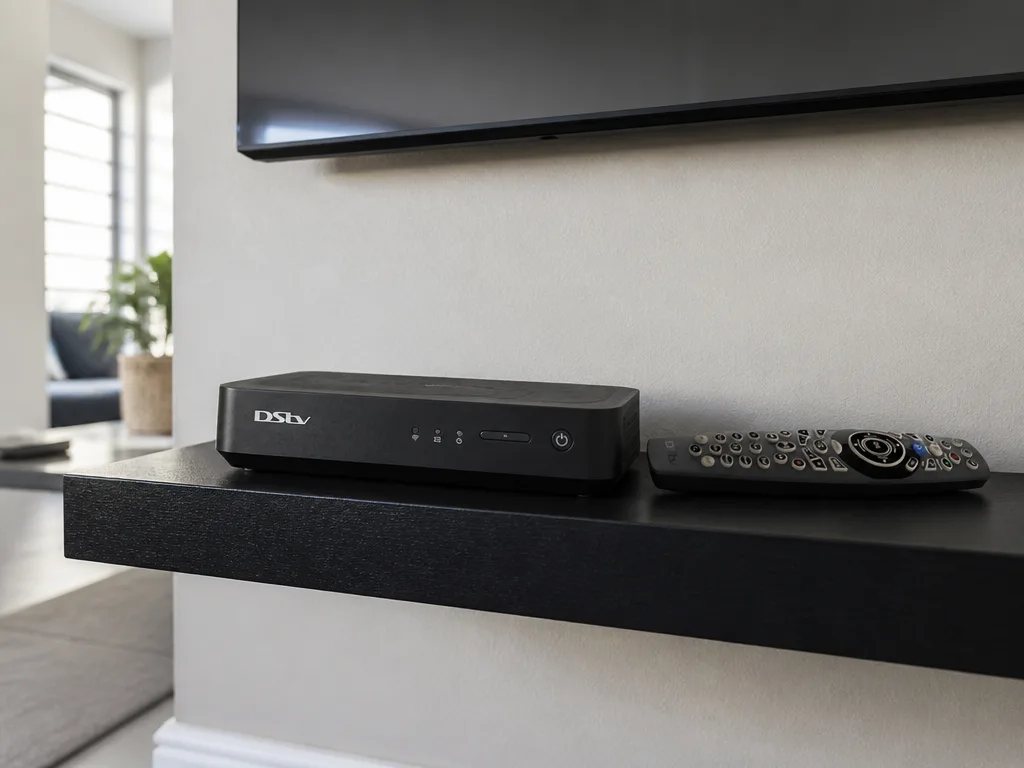
For customers who have recently upgraded to an Explora or Ultra decoder, we also confirm that the decoder firmware is current, as outdated firmware can cause signal quality readings to display incorrectly even when the RF signal chain is performing correctly. See our decoder upgrade service if your current hardware is not compatible with the latest HD channel lineup.
If you operate an Extra View setup across multiple rooms, we verify that the multi-switch or diplexer feeding all rooms is receiving adequate signal after the realignment. Storm events sometimes cause the multi-switch itself to fail if it was exposed to voltage spikes through the cable run, and this would prevent secondary rooms from receiving signal even after the main dish is correctly aligned. Our Extra View installation team handles these multi-room diagnostics as part of the service call.
Conclusion
When storm conditions displace your satellite dish, the correct way to align a DStv satellite dish after a storm involves a structured three-axis peaking process using a calibrated signal meter, followed by correct hardware torquing and full weatherproofing of all outdoor connections. Attempting to align a DStv satellite dish after a storm without a signal meter produces unreliable results in the majority of cases, as confirmed by field data showing that 68% of unassisted attempts require multiple revisits.
At DSTV Pro Installers, our dstv technician team serves 28 suburbs across Gauteng with same-day availability and a full dstv installation and alignment service priced from R650. We include LNB inspection, cable inspection, weatherproofing, and a post-alignment decoder test on every callout.
Call us on 0774544032 or visit our contact page to book your storm alignment today.
Frequently Asked Questions
How do I align a DStv satellite dish after a storm without a signal meter?
Technically, it is possible to attempt rough alignment using compass bearings and the decoder's on-screen signal test, but success rates without a signal meter are very low. Without a meter, you cannot confirm you are locked onto Intelsat 20 specifically, and you cannot peak the LNB skew correctly. We recommend calling a professional dstv technician for any storm-related alignment work.
What satellite does a DStv dish in Gauteng need to point to?
All DStv dishes in South Africa, including Gauteng, must be aligned to Intelsat 20 (IS-20) at 68.5 degrees East. When you align a DStv satellite dish after a storm, confirming the correct satellite by verifying a known transponder frequency is an essential step that prevents false signal lock on a neighbouring satellite.
How much does it cost to align a DStv satellite dish after a storm in Gauteng in 2026?
In 2026, our satellite dish alignment service is priced between R650 and R950 for the full procedure including LNB inspection, cable check, and weatherproofing. If the LNB or cable requires replacement, this is quoted separately after the on-site inspection confirms the fault.
Can a storm damage the LNB even if the dish itself looks fine?
Yes. Lightning-induced voltage spikes travelling through the coaxial cable are one of the most common causes of LNB failure after a storm, and the dish may appear undisturbed while the LNB is completely non-functional. Any storm-related service call should include a dedicated LNB test, which our dstv technician performs as a standard part of the dstv installation check process.
How long does it take to realign a DStv satellite dish after a storm?
A professional technician using a signal meter can typically complete the full alignment, hardware torquing, and weatherproofing within 30 to 45 minutes on a standard single-dish residential installation. Professional alignment tools reduce average calibration time from over 45 minutes to under 12 minutes for the peaking phase alone, with the remainder of the time spent on inspection and weatherproofing.
Will my DStv decoder be damaged if I use it with a misaligned dish?
Prolonged operation with a severely degraded signal can cause the decoder's error correction processor to run at sustained high load, which increases internal temperatures. Over an extended period this contributes to premature hardware degradation. It is always better to resolve the alignment issue promptly rather than continuing to use the system on a compromised signal.
Can dstv installers come the same day after a storm in Gauteng?
Yes. Our dstv installers offer same-day callouts across 28 Gauteng suburbs for storm-related signal faults including dish realignment, LNB replacement, and cable repair. Call 0774544032 to confirm availability in your area and book a same-day appointment.
Keep reading
In case you missed it
Planning a job? See realign your DSTV dish. Or browse our same-day DSTV installation in Silver Lakes and Faerie Glen DSTV installer service pages.
More to read: DSTV installation cost in Gauteng.